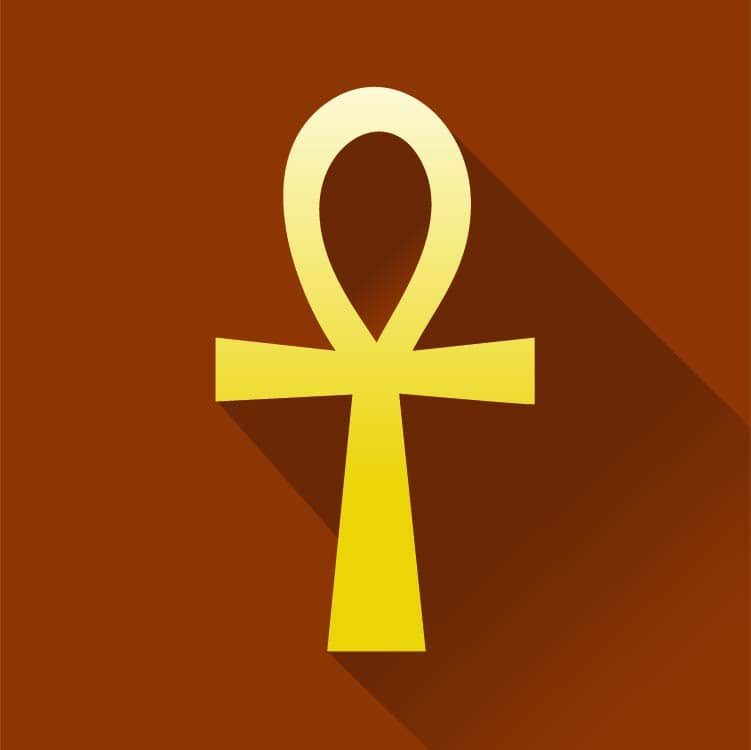
The Ankh: The Ancient Egyptian Key of Life and Symbol of Eternal Existence (Ankh cultures icon or Kemetism symbol brownish)
The image displays the Ankh, one of the most iconic and enduring symbols of Ancient Egyptian civilization. Recognized instantly by its distinctive looped top and cross-like lower structure, the Ankh is far more than a decorative hieroglyph. It is a profound representation of life, immortality, divine power, and cosmic balance, deeply woven into the religious, philosophical, and artistic fabric of ancient Egypt.
Often referred to as the “Key of Life” or the “Key of the Nile,” the Ankh symbolizes the essence of existence itself—both in the earthly realm and in the eternal afterlife. Over thousands of years, it has remained a powerful emblem of vitality, rebirth, and spiritual continuity, transcending its original cultural context to influence modern spirituality, fashion, art, and popular culture.
1 millions Christian tomb ancient RIP gravestones or tombstone crypt construction for dead Design Review
Shutterstock Profile (Cambridge Design Vector)
Origins of the Ankh in Ancient Egyptian Civilization (Ankh cultures icon or Kemetism symbol brownish)
The Ankh originated in Ancient Egypt, one of the world’s earliest and most influential civilizations, flourishing along the banks of the Nile River from around 3100 BCE. Egyptian culture was deeply centered on life, death, and rebirth, and the Ankh emerged as a visual expression of these interconnected concepts.
As a hieroglyphic character, the Ankh represented the word “life” (ankh in ancient Egyptian language). It appeared frequently in religious texts, wall carvings, tomb paintings, amulets, and temple reliefs. Unlike many hieroglyphs that represented sounds or objects, the Ankh conveyed an abstract, spiritual idea—life in its fullest, eternal sense.
The Meaning of the “Key of Life” (Ankh cultures icon or Kemetism symbol brownish)
The Ankh is commonly described as the Key of Life, a title that reflects its symbolic role as a gateway between mortal existence and eternal life. In Egyptian belief, life did not end with death; instead, death marked a transition to another form of existence in the afterlife.
The Ankh symbolized:
-
The continuation of life beyond death
-
The divine breath of life
-
The power to grant immortality
-
The soul’s journey into eternity
It was often shown being offered to the lips or nose of pharaohs and deities, symbolizing the breath of life—a divine gift necessary for survival both on earth and in the afterlife.
The Ankh as the “Key of the Nile” (Ankh cultures icon or Kemetism symbol brownish)
The Nile River was the lifeblood of Ancient Egypt. Its annual flooding deposited fertile silt that made agriculture possible in an otherwise desert environment. Without the Nile, Egyptian civilization could not have existed.
The Ankh’s association with the Key of the Nile reflects this reality. The symbol represented:
-
Water as a source of life
-
Agricultural fertility
-
Seasonal renewal
-
Prosperity and abundance
Some scholars believe the Ankh’s shape may symbolize the Nile River and its delta, reinforcing its connection to life-sustaining waters.
Shape and Structure of the Ankh (Ankh cultures icon or Kemetism symbol brownish)
The Ankh’s form is simple yet deeply symbolic. It consists of:
-
A loop or oval at the top
-
A vertical stem
-
A horizontal crossbar
This unique design has inspired numerous interpretations.
Symbolic Interpretations of the Ankh’s Shape (Ankh cultures icon or Kemetism symbol brownish)
Union of Opposites (Ankh cultures icon or Kemetism symbol brownish)
One interpretation suggests the Ankh represents the union of male and female principles:
-
The loop symbolizes femininity and the womb
-
The vertical line symbolizes masculinity
Together, they represent creation, balance, and the continuation of life.
Sun and Earth (Ankh cultures icon or Kemetism symbol brownish)
Another interpretation views the Ankh as a combination of:
-
The sun (the loop)
-
The horizon (the crossbar)
-
The path of the sun (the vertical line)
This aligns with Egyptian solar worship and the belief that the sun’s daily journey represented death and rebirth.
Elements of Life (Ankh cultures icon or Kemetism symbol brownish)
Some scholars propose the Ankh symbolizes essential elements:
-
Water (the Nile)
-
Air (breath of life)
-
Sun (energy and growth)
These elements were considered essential for sustaining life in Egyptian cosmology.
The Ankh in Egyptian Religion (Ankh cultures icon or Kemetism symbol brownish)
Religion permeated every aspect of Ancient Egyptian life, and the Ankh played a central role in religious imagery and ritual.
Gods and the Ankh (Ankh cultures icon or Kemetism symbol brownish)
Egyptian gods are frequently depicted holding Ankhs, particularly:
-
Anubis, god of mummification and the afterlife
-
Osiris, god of resurrection and eternal life
-
Isis, goddess of magic, healing, and motherhood
-
Ra, the sun god and creator deity
In these depictions, the Ankh symbolizes divine authority over life and death.
Pharaohs and Divine Right (Ankh cultures icon or Kemetism symbol brownish)
Pharaohs were believed to be divine or semi-divine rulers, acting as intermediaries between gods and humans. The Ankh symbolized:
-
Their divine legitimacy
-
Their role as life-givers and protectors
-
Their guaranteed place in the afterlife
Images often show gods presenting the Ankh to the pharaoh, affirming divine favor and eternal life.
The Ankh and the Afterlife (Ankh cultures icon or Kemetism symbol brownish)
Belief in the afterlife was central to Egyptian spirituality. Life on earth was seen as a temporary stage before entering the eternal realm.
The Ankh represented:
-
Assurance of life after death
-
Spiritual continuity
-
The soul’s rebirth
It was commonly included in tomb decorations, burial objects, and funerary art to ensure safe passage into the next world.
The Ankh in Funerary Practices (Ankh cultures icon or Kemetism symbol brownish)
Ancient Egyptians placed Ankhs in:
-
Coffins
-
Sarcophagi
-
Amulets worn by the deceased
These objects were believed to provide protection, vitality, and resurrection in the afterlife.
The Ankh as an Amulet (Ankh cultures icon or Kemetism symbol brownish)
Amulets were widely used in Ancient Egypt to ward off evil and attract positive forces. The Ankh was one of the most powerful amulets, believed to:
-
Protect against illness and harm
-
Strengthen life force
-
Ensure longevity
People wore Ankh amulets in daily life as well as in burial rites.
Artistic Representation of the Ankh (Ankh cultures icon or Kemetism symbol brownish)
The Ankh appears across all forms of Egyptian art:
-
Wall reliefs
-
Temple carvings
-
Jewelry
-
Paintings and sculptures
Artists rendered the symbol with great care, often in gold or precious materials to reflect its sacred nature.
Relationship Between the Ankh and the Cross (Ankh cultures icon or Kemetism symbol brownish)
Due to its cross-like shape, the Ankh is sometimes compared to the Christian cross. However, its meaning is distinct:
-
The Ankh represents life and immortality
-
The Christian cross represents sacrifice and redemption
Despite differences, early Christians in Egypt (Coptic Christians) adopted the Ankh-like cross as a symbol of eternal life.
Philosophical Meaning of the Ankh
Beyond religion, the Ankh reflects a philosophical worldview centered on:
-
Harmony between nature and humanity
-
Cycles of life and death
-
Balance between material and spiritual realms
It embodies the idea that life is continuous, interconnected, and sacred.
The Ankh in Modern Spirituality
In modern times, the Ankh has been embraced by various spiritual movements as a symbol of:
-
Eternal consciousness
-
Energy flow
-
Spiritual awakening
-
Reincarnation
It is often used in meditation practices and holistic belief systems.
The Ankh and Reincarnation
Although Ancient Egyptian beliefs about reincarnation differed from Eastern traditions, the Ankh is sometimes associated with rebirth and cyclical existence in modern interpretations.
It symbolizes:
-
Renewal of the soul
-
Continuous spiritual evolution
-
Transformation across lifetimes
The Ankh in Contemporary Culture
Today, the Ankh appears in:
-
Jewelry and fashion
-
Tattoos
-
Art and design
-
Music and popular media
Its appeal lies in its timeless design and universal message of life and vitality.
Cultural Identity and Afrocentric Symbolism
The Ankh has become an important symbol in Afrocentric and African diasporic movements, representing:
-
Cultural heritage
-
Ancestral wisdom
-
Connection to ancient African civilizations
It serves as a symbol of pride, resilience, and historical continuity.
Symbol of Power and Authority
In ancient depictions, gods holding Ankhs emphasize:
-
Control over life force
-
Authority over creation
-
Divine responsibility
This reinforces the idea that life itself is sacred and governed by higher principles.
Design Simplicity and Timelessness
One reason for the Ankh’s lasting relevance is its simple, elegant design. It is:
-
Easily recognizable
-
Visually balanced
-
Adaptable to different artistic styles
This makes it ideal for modern reinterpretation.
Educational and Academic Significance
The Ankh is studied in:
-
Egyptology
-
Religious studies
-
Art history
-
Anthropology
It provides insight into how ancient cultures understood existence, death, and the cosmos.
The Ankh as a Universal Symbol of Life
Although rooted in Egyptian culture, the Ankh resonates universally. Life, renewal, and continuity are concepts shared by all human societies.
This universality explains why the Ankh continues to inspire across cultures and generations.
Conclusion (Ankh cultures icon or Kemetism symbol brownish)
The Ankh is far more than an ancient hieroglyph—it is a timeless symbol of life, eternity, and spiritual balance. As the Key of Life and Key of the Nile, it encapsulates the essence of Ancient Egyptian belief: that life is sacred, cyclical, and eternal.
Through its association with gods, pharaohs, the afterlife, and the forces of nature, the Ankh became a central emblem of existence itself. Its enduring presence in art, spirituality, and modern culture speaks to its profound symbolic power.
Even thousands of years after its creation, the Ankh continues to remind humanity of a universal truth: life is not merely a moment in time, but a continuous journey—one that transcends physical boundaries and connects the mortal with the eternal.





There are no reviews yet.